

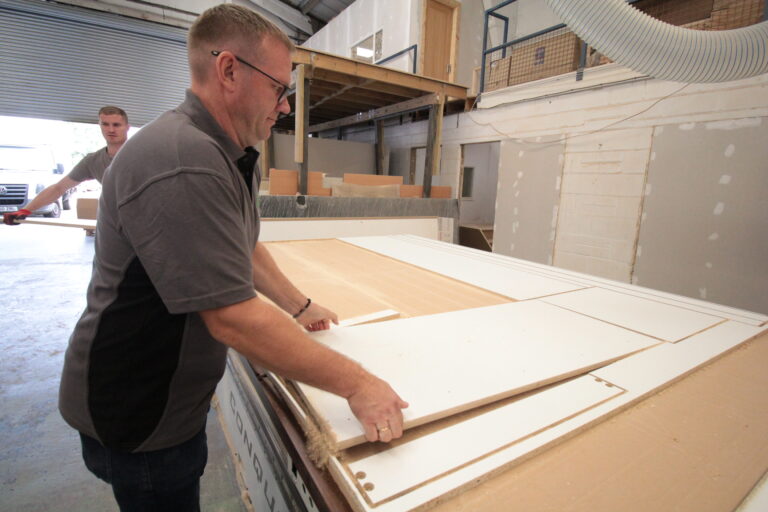
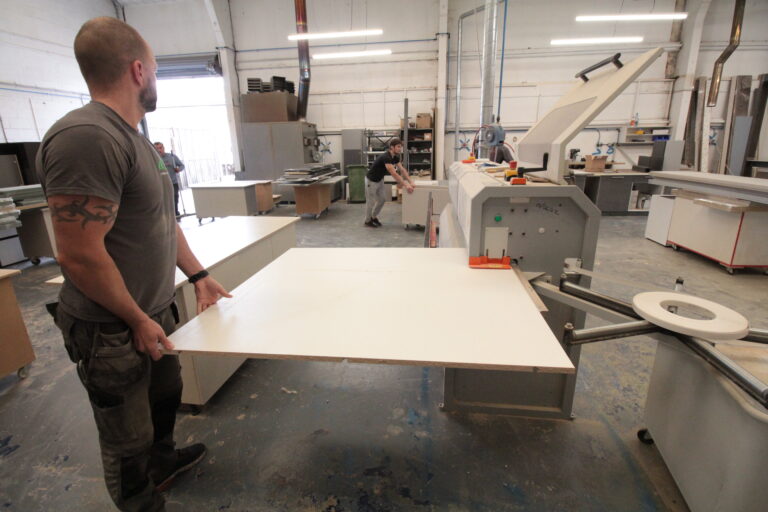
A clear cutting list is the difference between panels that drop straight into place and a frustrating second trip. This guide shows you exactly what we need to cut, edge and machine your boards accurately at our Peterborough workshop.
1. Measure everything in millimetres
Always work in millimetres, never inches or centimetres. Write length first, then width – for example 720 x 560. Measure twice, and if you are fitting into an existing space, take measurements at the top, middle and bottom because walls are rarely perfectly square.
2. List every part on its own line
For each different panel, give us:
- Part name – e.g. “base unit side”, “shelf”, “door”. It makes checking much easier.
- Quantity – how many identical pieces you need.
- Length x width in mm.
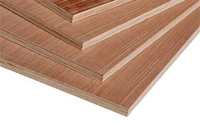
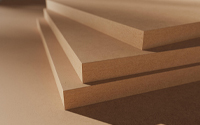
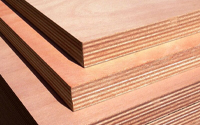
- Material and thickness – e.g. 18mm MFC, 18mm MDF, 18mm birch plywood.
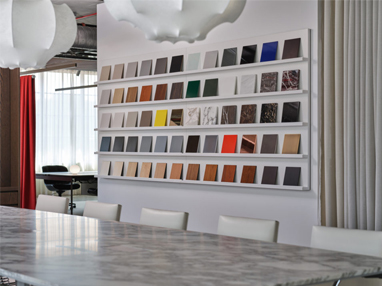
- Decor name and code – e.g. Egger H1145 ST10 Natural Bardolino Oak. The code matters, as many decors have similar names.
- Edging – which edges need banding and what thickness (see below).
- Any drilling or CNC work – hinge holes, shelf pin holes, grooves, cut-outs.
3. Mark the grain direction
Woodgrain and textured decors have a direction. Put the dimension that runs with the grain first and mark it clearly on your list. If a panel is plain colour with no grain, say so – it lets us nest your parts more efficiently on the sheet and can reduce waste.
4. Use the L1, L2, W1, W2 edging code
We describe edges using a simple code, which you will also see on our online cutting list:
- L1 / L2 – the two long edges (the length).
- W1 / W2 – the two short edges (the width).
For each panel, tell us which of these four edges need banding and the thickness you want, for example “L1 2mm, W1 W2 1mm”. Not sure which thickness to choose? Read our edgebanding guide.
5. Finished sizes or cut sizes?
Edging adds thickness to a panel. Please state clearly whether your sizes are the finished size (including edging) or the cut size (before edging). If you are unsure, give us finished sizes and tell us – we will check your list with you before anything is cut.
6. Allow for the saw blade
Every cut removes a few millimetres of board (the saw kerf). When working out how many sheets you need, do not assume you can fit parts edge-to-edge with zero waste. As a guide, standard decorative MFC sheets are 2800 x 2070mm and MDF and plywood are commonly 2440 x 1220mm – we will confirm the exact sheet size for the material you choose.
Common mistakes to avoid
- Mixing up length and width on grained decors, so the grain runs the wrong way.
- Forgetting to subtract the thickness of the sides when sizing shelves and bases (18mm board x 2 = 36mm).
- Leaving out edging on the visible front edge of shelves.
- Giving a decor name without the code.
- Rounding measurements – 597mm is not 600mm.
Ready to send your list?
Use our online cutting list, or send it as a photo, spreadsheet or PDF. Call 07791 290848, WhatsApp 07479 219421 or email cutandedgexpress@gmail.com. Our standard lead time is 5 working days. See also: boards cut to size and edgebanding services.